Colour
Description.
How we observe, measure, and communicate gemstone colour — using a systematic framework of hue, saturation, and tone supported by spectrophotometric analysis.
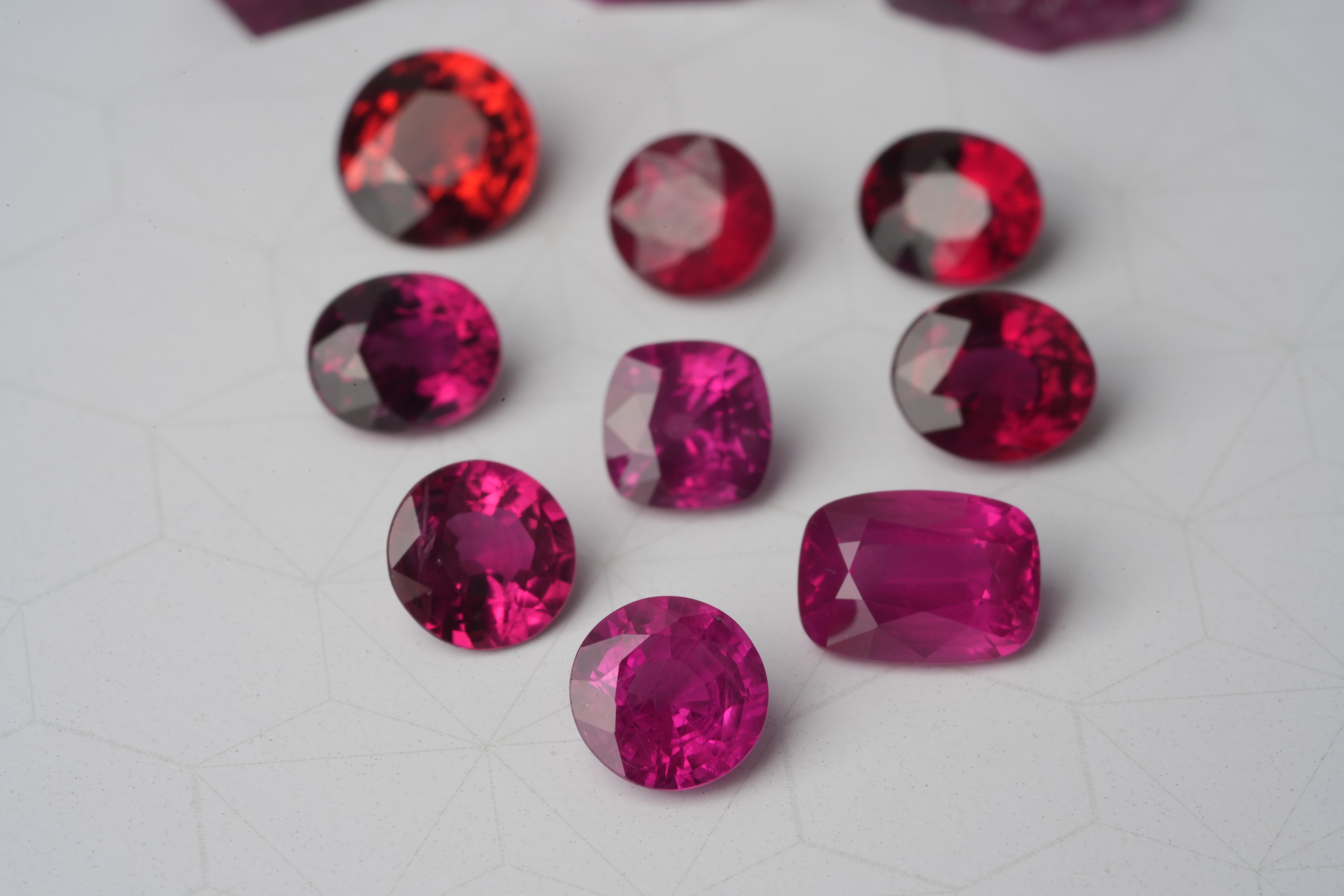
Hue, Saturation, Tone.
Gemstone colour is described using a three-dimensional framework that separates the perceptual components of colour into independently assessable attributes. This approach provides a standardised, repeatable method for communicating colour in our reports.
Colour assessment is performed under standardised lighting conditions (D65 daylight equivalent) and supported by UV-Vis-NIR spectrophotometry to correlate visual observations with quantitative spectral data.
Hue
The dominant spectral colour — red, orange, yellow, green, blue, violet, and intermediaries.
Saturation
The intensity or vividness of the hue — from desaturated (greyish) to vivid (pure spectral colour).
Tone
The lightness or darkness of the colour — from very light to very dark.
How Colour Appears in Our Reports.
| Gemstone | Report Colour | Comment |
|---|---|---|
| Ruby |
Red
|
Colour is implied by variety name |
| Blue Sapphire |
Blue
|
Standard colour prefix |
| Padparadscha |
Pinkish-orange
|
Requires specific hue range qualification |
| Emerald |
Green
|
Must meet minimum saturation threshold |
| Alexandrite |
Colour-change
|
Two colours reported (daylight + incandescent) |
Beyond Visual Assessment.
While experienced visual assessment remains central, our colour descriptions are supported by UV-Vis-NIR spectrophotometry. This instrumental data identifies the chromophores responsible for colour, corroborates visual observations, and — in critical cases — provides objective boundaries for variety-defining colour determinations.
Illustrative UV-Vis absorption spectrum showing chromophore-related absorption features used in colour cause determination.
See Colour in Context.
View how our colour descriptions and spectrophotometric data appear in actual reports.
View Report Types